

TL;DR
- Traditional CRM data stacks were designed for human workflows — batch exports, stale snapshots, and zero API-first design make them structurally incompatible with AI agents that need real-time, deterministic data access.
- Autonomous GTM infrastructure requires four distinct layers: identity resolution, enrichment, signal streaming, and orchestration — each with different latency, reliability, and consistency guarantees.
- Synchronous data access is non-negotiable for agents operating inside live decision loops; async enrichment is only acceptable for background context-building tasks outside the critical path.
- MCP server architecture gives agents a standardized, tool-native interface to query company and people data without custom integration code, enabling faster agent development and more reliable pipelines.
- Identity resolution at query time — matching across domains, emails, LinkedIn URLs, and firmographic signals — must happen in milliseconds to avoid blocking agent reasoning steps.
- Signal stream architecture separates real-time triggers (job postings, funding rounds, tech installs) from periodic signals (intent surges, CRM health scores) so agents can prioritize without data confusion.
- 97.8%+ company match accuracy and deterministic, deduplicated entity IDs are the baseline reliability requirements for any B2B data layer feeding autonomous GTM agents at scale.
Why Your Existing Data Stack Will Break Your GTM Agents
When engineering and revenue teams start building autonomous GTM agents — systems that can research accounts, qualify leads, personalize outreach, and trigger follow-up sequences without human intervention — they almost always make the same mistake: they assume the data infrastructure that supported their existing CRM workflows will support agents too. It won’t. The problem isn’t the data itself. It’s the architectural assumptions baked into every layer of a traditional B2B data stack.
Traditional GTM data architecture was designed around human latency. A sales rep logging into Salesforce can wait 500 milliseconds for a page to load. A marketing ops analyst running a weekly enrichment job can wait 24 hours for a CSV to process. A RevOps dashboard refreshing on a nightly batch cycle is perfectly adequate when humans check it once a day. But an AI agent operating inside a live decision loop — scoring an inbound lead, deciding whether to send outreach, choosing which contact to sequence first — cannot wait. The agent needs data in the same call, synchronously, with deterministic results it can reason over.
This article is a technical guide to building autonomous GTM data infrastructure that actually works for agents. We’ll cover the four layers every agent-ready data stack needs, the specific API and latency requirements agents demand, how to architect identity resolution and signal streaming for machine consumers, and how platforms like Explorium’s AgentSource MCP server fit into production autonomous GTM pipelines. If you’re building AI agents that touch B2B data, this is the infrastructure conversation you need to have before you write a single line of agent code.
The Four Structural Failures of Traditional CRM Data Stacks
Before designing the right architecture, it’s worth being precise about why the wrong one fails. Traditional B2B data stacks — Salesforce enriched by ZoomInfo or Clearbit via nightly syncs, intent data delivered as weekly CSV files, technographic data updated monthly — have four specific structural failures when AI agents try to consume them.
Failure 1: Batch-first data delivery. The overwhelming majority of B2B data infrastructure was built assuming that data would be moved in bulk on a schedule. Nightly ETL jobs, weekly enrichment runs, monthly intent refreshes. This batch-first assumption permeates every layer: data models are optimized for bulk reads, not point queries; APIs are rate-limited for reporting workloads, not agent loops; caching strategies assume data won’t change more than once a day. When an agent needs to look up a company’s current headcount, funding stage, and recent hiring signals in a single reasoning step, a batch-first stack has no good answer.
Failure 2: Stale snapshot data. CRM records are snapshots of reality at the moment they were last enriched. That might have been last week, last month, or — for records that haven’t been touched in a while — last year. For human workflows, staleness is a nuisance. For autonomous agents, it’s a silent failure mode. An agent deciding whether to reprioritize an account based on recent Series B funding will make a wrong decision if the CRM record still shows the company at Seed stage. Agents can’t interrogate data freshness; they consume whatever they’re given and treat it as ground truth.
Failure 3: No API-first design for machine consumers. Most B2B data vendors built their APIs as an afterthought — a way to power their own UI or enable one-way sync into CRMs, not a first-class interface for machine consumers. This shows up in API design patterns that are hostile to agents: pagination-heavy list endpoints instead of point-lookup endpoints; no support for partial field retrieval; response schemas that change without versioning; authentication flows that assume a human is present to handle token refresh. Agents need APIs designed for machines: low-latency point queries, stable schemas, and programmatic authentication.
Failure 4: No entity identity layer. The most underappreciated failure is the absence of a stable identity layer. When a human looks up a company in Salesforce, they can reconcile that “Acme Corp” in the CRM is the same as “Acme Corporation” in a ZoomInfo export and “acme.com” in a web form submission. Agents cannot do this reconciliation unless the data layer provides stable, deduplicated entity IDs. Without a canonical identity layer, agents operating across multiple data sources will double-count companies, miss matches, and produce inconsistent outputs that corrupt downstream workflows.
These four failures aren’t bugs — they’re the predictable result of building data infrastructure for human workflows and then trying to repurpose it for machine consumers. The fix isn’t patching the existing stack; it’s understanding what a purpose-built autonomous GTM data infrastructure needs to look like from the ground up.
The Four Layers of Autonomous GTM Data Infrastructure
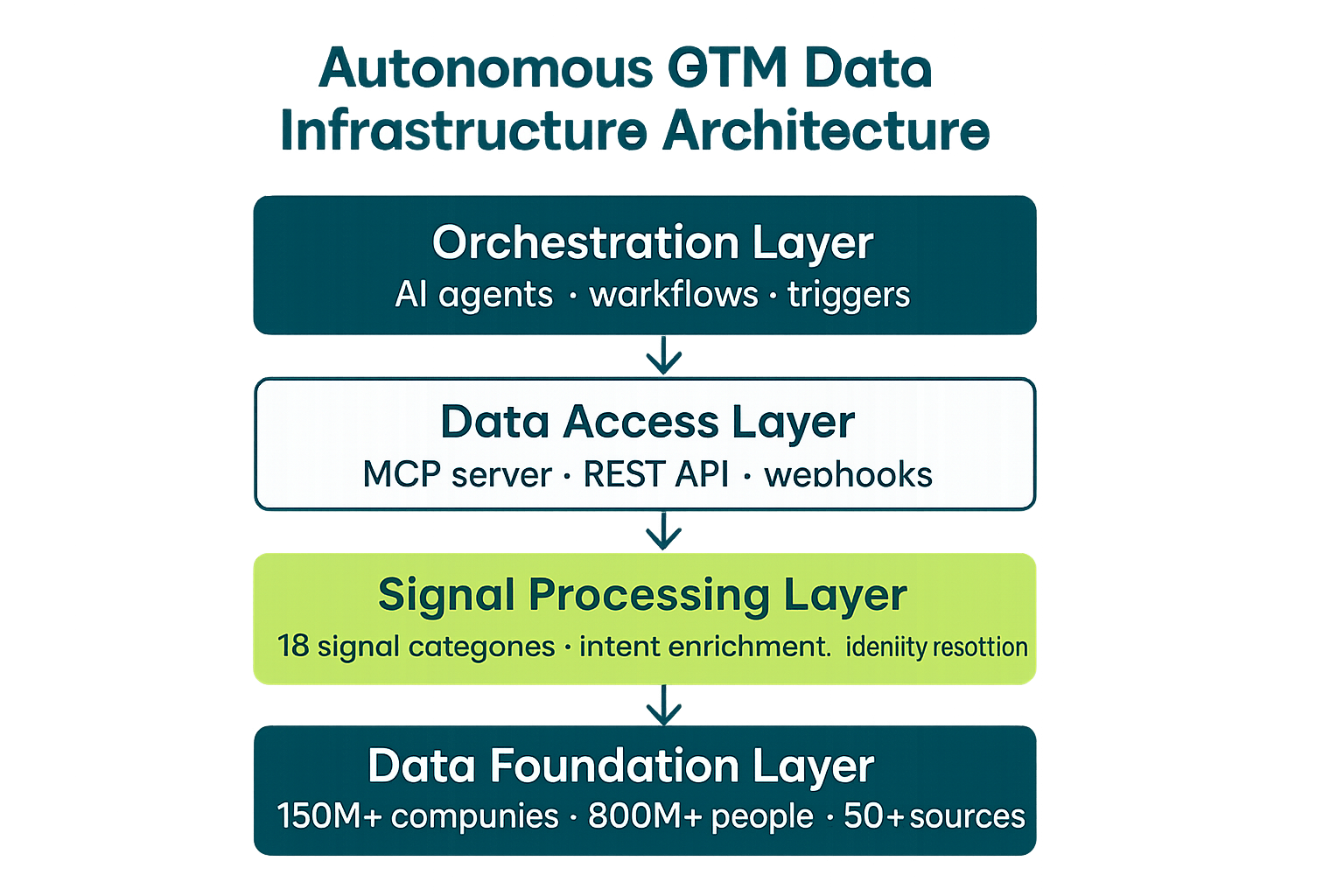
Agent-ready GTM data infrastructure has four distinct layers, each serving a different function in the agent decision loop. Getting the layer boundaries right matters: conflating enrichment with signal streaming, or identity resolution with orchestration, leads to architectures that are hard to debug, unreliable under load, and impossible to evolve incrementally.
| Layer | Function | Latency Requirement | Primary Consumer | Data Freshness |
|---|---|---|---|---|
| Identity Resolution | Match input identifiers to canonical entity IDs | <50ms p99 | All agents (entry point) | Near-real-time |
| Enrichment | Return structured firmographic and contact attributes | <200ms p99 | Qualification, personalization agents | Weekly refresh minimum |
| Signal Streaming | Deliver time-stamped behavioral and intent signals | <500ms p99 (real-time signals) | Prioritization, trigger agents | Real-time to daily depending on signal type |
| Orchestration | Coordinate multi-step agent workflows across data sources | Workflow-level SLA (seconds to minutes) | Autonomous workflow engines | Composed from upstream layers |
Layer 1: Identity Resolution. Every agent interaction starts with an identifier — a domain name from a web form, an email address from an inbound inquiry, a LinkedIn URL from a prospecting tool, or a company name from a news article. Before the agent can do anything useful with this identifier, it needs to resolve it to a canonical entity. This is identity resolution: the process of matching fuzzy, partial, or ambiguous inputs to stable, deduplicated entity records.
Identity resolution at query time is structurally different from the batch entity matching that most data providers do. Batch matching can afford to be slow and compute-intensive because it runs in the background. Query-time matching must be fast enough to not block agent reasoning — under 50 milliseconds for a p99 response. This requires pre-built matching indexes, not on-the-fly fuzzy matching. A production identity resolution layer maintains inverted indexes on every matchable identifier (domain, email domain, LinkedIn company ID, phone number, DUNS number) and resolves incoming identifiers against these indexes in memory.
The output of identity resolution must be a stable, deterministic entity ID. Not a name, not a domain — a UUID or similar identifier that will be the same every time for the same company, regardless of which input identifier triggered the lookup. This stable ID becomes the foreign key that ties together enrichment data, signal data, and CRM records across the entire autonomous GTM infrastructure.
Layer 2: Enrichment. Once the agent has a canonical entity ID, enrichment returns the structured attributes the agent needs to reason over: company size, industry, technology stack, location, revenue estimates, headcount growth, funding history, and contact-level data including job titles, seniority, and contact information. For a B2B data enrichment layer serving agents, the critical requirements are different from those serving human analysts.
Agents need enrichment APIs to be synchronous and low-latency, returning complete records in a single call rather than requiring agents to page through results or make multiple requests to assemble a full profile. They need stable response schemas — an agent’s reasoning logic is essentially a parser for enrichment data, and schema changes break agents silently. And they need the ability to specify exactly which fields they want in a single request, rather than receiving full records and discarding most of the payload.
Layer 3: Signal Streaming. Enrichment tells agents what a company is. Signal streaming tells agents what a company is doing right now. B2B buying signals — job postings, technology installations, funding announcements, executive changes, intent spikes, product review activity — are what transform autonomous GTM agents from simple data lookups into genuine decision-making systems. Without signal streaming, agents can only rank accounts by static firmographic fit. With it, they can prioritize the accounts that are showing active buying behavior today.
Layer 4: Orchestration. The orchestration layer coordinates how agents move through the first three layers to accomplish multi-step GTM workflows. This isn’t a data layer in the traditional sense — it’s the routing, sequencing, and error-handling logic that determines how agents compose identity resolution, enrichment, and signal queries into coherent workflows. A well-designed orchestration layer treats each underlying data call as a tool with defined inputs, outputs, and failure modes, and routes agent execution accordingly.
Synchronous vs. Async Data Access Patterns for GTM Agents
One of the most consequential architectural decisions in autonomous GTM data infrastructure is where to draw the line between synchronous and asynchronous data access. Getting this wrong means either building agents that block indefinitely on slow data calls (synchronous overuse) or agents that act on stale context because they couldn’t wait for fresh data (async overuse).
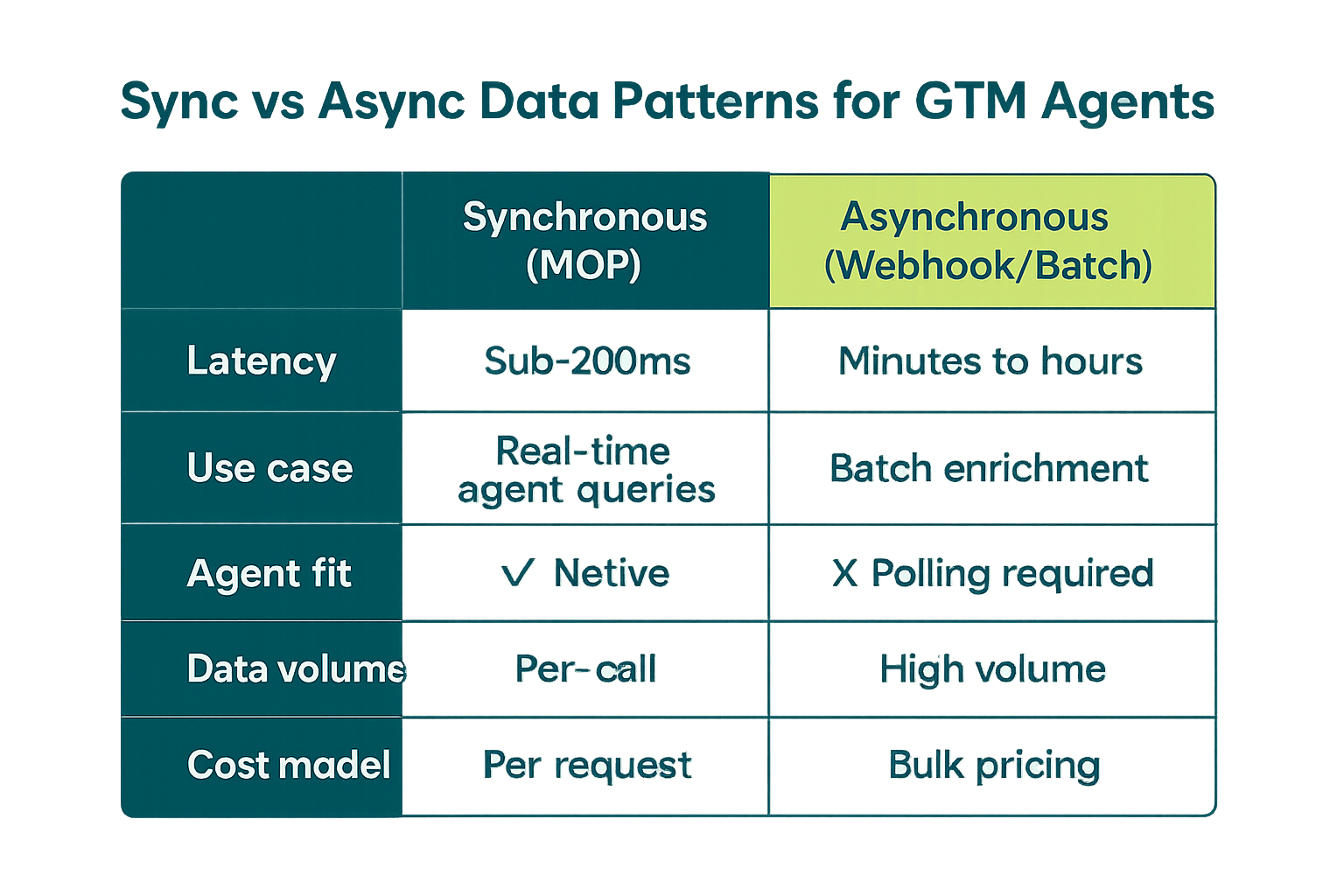
The rule of thumb is simple: any data call that is on the critical path of a live agent decision must be synchronous. Any data call that builds background context outside the live decision loop can be asynchronous.
| Data Operation | Access Pattern | Max Acceptable Latency | Why |
|---|---|---|---|
| Identity resolution (inbound lead) | Synchronous | 50ms p99 | Blocks lead routing decision |
| Firmographic enrichment (qualification) | Synchronous | 200ms p99 | Blocks qualification scoring |
| Real-time signal check (trigger evaluation) | Synchronous | 300ms p99 | Blocks outreach timing decision |
| Full contact list retrieval | Async (pre-fetch) | 5 seconds acceptable | Not on critical path; can be cached |
| Intent data weekly refresh | Async (batch) | Hours acceptable | Background context enrichment |
| CRM record sync | Async (event-driven) | Minutes acceptable | Updates don’t block agent decisions |
The practical implication of this pattern is that you need two distinct data access paths in your autonomous GTM infrastructure: a low-latency synchronous path for critical-path queries, and a higher-throughput asynchronous path for background enrichment. These paths have different infrastructure requirements. The synchronous path needs pre-computed indexes, in-memory caching, and aggressive p99 SLAs. The async path needs high throughput, retry logic, and idempotent processing guarantees.
Most B2B data vendors only have one path — typically the async batch path — because that’s what their traditional customers needed. Building autonomous GTM agents on top of a single async path means either accepting unacceptable latency on critical decisions or building complex caching layers that introduce their own freshness and consistency problems. The right solution is a data platform that was designed from the start to support both access patterns, with the synchronous path as a first-class offering rather than an afterthought.
For teams building their first autonomous GTM agents, the most common mistake is attempting to simulate synchronous access by pre-loading all relevant enrichment data into the agent’s context at the start of a workflow. This works for small workflows with a fixed set of accounts but breaks down quickly as the number of accounts grows or as agents need to discover new accounts dynamically during execution. A genuine synchronous data API is the only scalable answer.
MCP Server Architecture for Agent-Native Data Access
The Model Context Protocol (MCP) has emerged as the dominant standard for giving AI agents structured access to external data and tools. For autonomous GTM data infrastructure, MCP servers provide a clean architectural boundary between the agent reasoning layer and the data layer — agents call MCP tools, MCP tools call data APIs, and the agent never needs to know how the data is fetched or assembled.
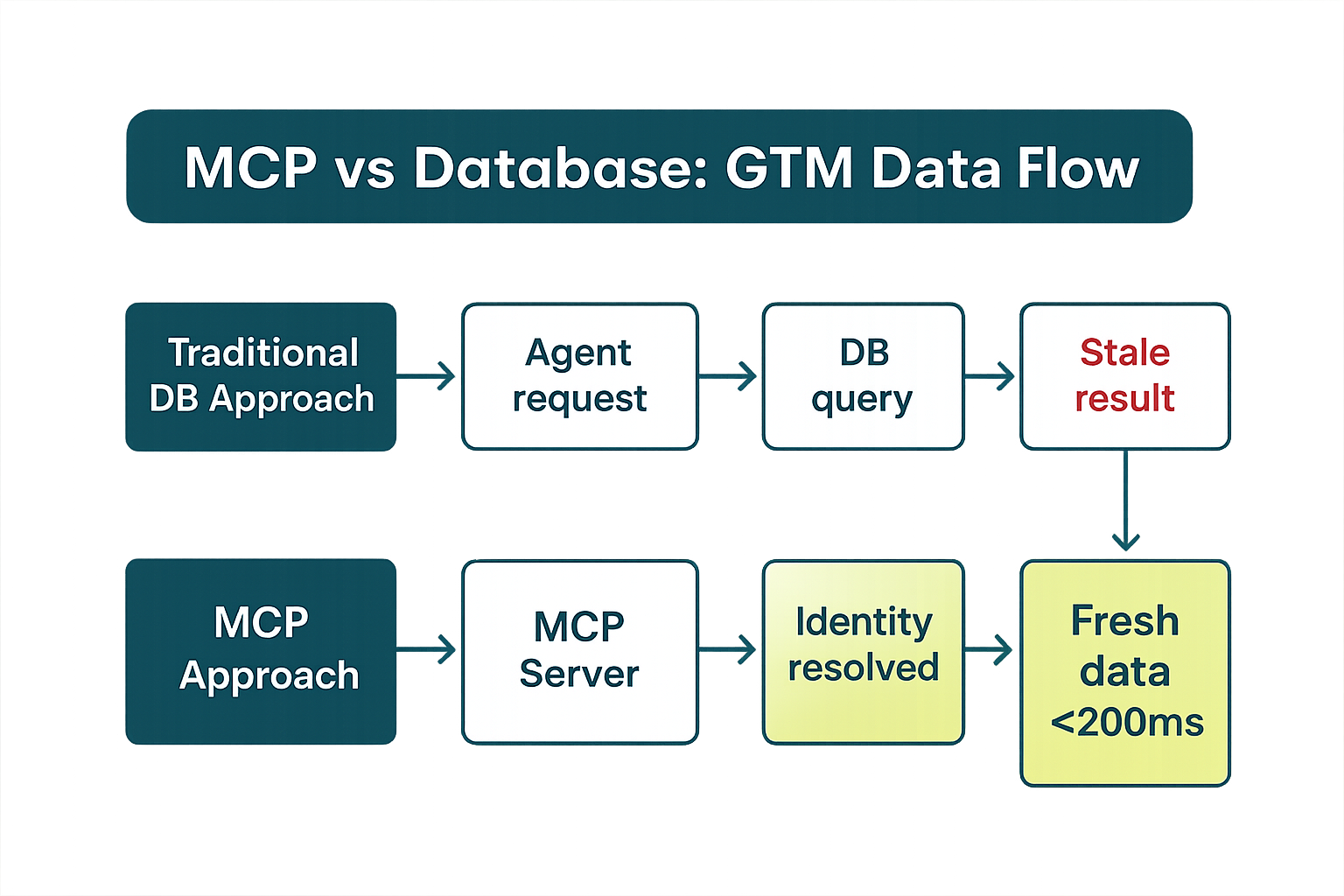
An MCP server for B2B data exposes a set of tools that agents can call during reasoning. A well-designed GTM data MCP server exposes tools along the lines of the following pattern:
# Example: Agent calling Explorium AgentSource MCP tools during GTM workflow
import anthropic
from mcp import ClientSession, StdioServerParameters
from mcp.client.stdio import stdio_client

async def run_gtm_agent(inbound_lead: dict):
    server_params = StdioServerParameters(
        command="explorium-mcp",
        args=["--api-key", EXPLORIUM_API_KEY],
        env=None
    )

    async with stdio_client(server_params) as (read, write):
        async with ClientSession(read, write) as session:
            await session.initialize()

            # Step 1: Resolve identity from inbound lead data
            identity = await session.call_tool(
                "resolve_company_identity",
                arguments={
                    "domain": inbound_lead.get("company_domain"),
                    "company_name": inbound_lead.get("company_name"),
                    "email": inbound_lead.get("email")
                }
            )
            company_id = identity.content[0].text  # Stable canonical ID

            # Step 2: Enrich company profile synchronously
            profile = await session.call_tool(
                "get_company_profile",
                arguments={
                    "company_id": company_id,
                    "fields": ["headcount", "industry", "funding_stage",
                                "technologies", "revenue_estimate", "hq_country"]
                }
            )

            # Step 3: Check active buying signals
            signals = await session.call_tool(
                "get_buying_signals",
                arguments={
                    "company_id": company_id,
                    "signal_categories": ["hiring", "funding", "intent", "technology"],
                    "lookback_days": 30
                }
            )

            # Step 4: Agent reasons over enriched context
            client = anthropic.Anthropic()
            response = client.messages.create(
                model="claude-opus-4-5",
                max_tokens=1024,
                messages=[{
                    "role": "user",
                    "content": f"""
                    Score this inbound lead for enterprise fit and buying readiness.
                    Company profile: {profile.content[0].text}
                    Active signals (last 30 days): {signals.content[0].text}
                    Original lead data: {inbound_lead}

                    Return a JSON object with: fit_score (0-100), readiness_score (0-100),
                    recommended_action, and reasoning.
                    """
                }]
            )
            return response.content[0].text
This pattern has several important properties from an infrastructure standpoint. The agent code is completely decoupled from the data fetching logic — if Explorium’s underlying API changes, only the MCP server needs to update, not every agent that uses it. The MCP tool interface provides a stable contract that agent developers can rely on. And because MCP servers handle authentication, rate limiting, and error handling internally, agent developers don’t need to implement these concerns themselves.
The JSON schema for signal payloads flowing through an MCP server should be designed for agent consumption, not human readability. Agents need structured, typed data they can reliably parse, not the kind of narrative descriptions that appear in sales intelligence tools built for human readers. A well-designed signal schema makes the signal type, confidence, timestamp, and structured attributes available as discrete typed fields, not as prose that a language model would need to interpret:
{
  "$schema": "http://json-schema.org/draft-07/schema#",
  "title": "BuyingSignalPayload",
  "type": "object",
  "required": ["company_id", "signal_type", "signal_category", "detected_at", "confidence", "attributes"],
  "properties": {
    "company_id": {
      "type": "string",
      "description": "Stable canonical company entity ID"
    },
    "signal_type": {
      "type": "string",
      "enum": ["job_posting", "funding_round", "technology_install",
                "executive_change", "intent_surge", "product_review",
                "expansion_signal", "competitive_displacement"]
    },
    "signal_category": {
      "type": "string",
      "enum": ["hiring", "funding", "technology", "leadership",
                "intent", "social", "news", "regulatory"]
    },
    "detected_at": {
      "type": "string",
      "format": "date-time",
      "description": "ISO 8601 timestamp when signal was first detected"
    },
    "confidence": {
      "type": "number",
      "minimum": 0,
      "maximum": 1,
      "description": "Signal confidence score from 0.0 to 1.0"
    },
    "attributes": {
      "type": "object",
      "description": "Signal-type-specific structured attributes",
      "additionalProperties": true
    },
    "expires_at": {
      "type": "string",
      "format": "date-time",
      "description": "Timestamp after which signal should be considered stale"
    }
  }
}
The MCP server configuration for a production autonomous GTM deployment also needs to specify reliability and performance guarantees that agent orchestrators can use for routing and retry logic. Tool-level SLAs, fallback behavior on timeout, and idempotency guarantees for each exposed tool should all be declared explicitly in the server manifest so that agent frameworks can make intelligent scheduling decisions without requiring developers to hardcode retry logic in each agent implementation.
Building AI agents that need reliable B2B data? Explorium’s AgentSource MCP server delivers 150M+ company profiles at 100 QPS with synchronous response — purpose-built for autonomous GTM workflows. See the architecture →
Identity Resolution at Query Time: The Technical Requirements
Identity resolution is the most underspecified component in most autonomous GTM data infrastructure designs. Teams spend weeks debating enrichment providers and signal vendors, then treat identity resolution as a simple lookup that any API can handle. This is a mistake. Identity resolution is architecturally the most demanding component in the entire stack, and getting it wrong corrupts every downstream layer.
The challenge is that B2B entity identity is inherently ambiguous. A single company might appear in your data sources as “Acme Corp”, “Acme Corporation”, “ACME”, “acme.com”, “acme.io”, “Acme (acquired by BigCo)”, and seventeen variants of LinkedIn company URL. A contact at that company might appear with five different email addresses across different touchpoints. Traditional entity resolution approaches — fuzzy string matching, domain-based deduplication — work reasonably well in batch processing where you have time to compute similarity scores across millions of record pairs. They don’t work at query time, where you need a match decision in under 50 milliseconds.
Production query-time identity resolution requires a pre-built, multi-dimensional matching index. This index is constructed offline using all the compute-intensive fuzzy matching and entity linking algorithms you want, then serialized into a fast lookup structure that can resolve any incoming identifier in constant time. The index maps every known identifier variant for a company — every known domain, email domain, LinkedIn ID, phone number, and name variant — to a single canonical entity ID.
At query time, the resolution algorithm is essentially a hash lookup: take the incoming identifier, normalize it (lowercase, strip www., standardize LinkedIn URL format), and look it up in the index. If it’s there, return the canonical ID. If it’s not there — because the entity is new, or because it arrived in a format not seen during index construction — fall back to a more expensive fuzzy match operation, but accept that this will be slower and less certain.
For autonomous GTM agents, the resolution layer needs to handle several failure modes gracefully. When a domain resolves to multiple companies (subsidiaries, acquisitions, holding companies), the resolution layer must return the most likely entity with a confidence score and allow the agent to decide how to handle ambiguity. When no match is found at all, the resolution layer must return a clear no-match signal rather than a null response that agents might misinterpret. And when the same company appears under multiple IDs due to data quality issues, the resolution layer must have a deduplication mechanism that merges these into a single canonical record.
Explorium’s identity resolution achieves 97.8%+ company match accuracy by maintaining matching indexes across 50+ data sources and running continuous deduplication against its canonical company graph of 150M+ profiles and 800M+ people profiles. This level of accuracy is the baseline requirement for autonomous GTM agents — lower match rates mean agents regularly fail to find context for companies they should know about, silently degrading the quality of every downstream decision. For teams evaluating identity resolution options, the test is simple: take 1,000 real inbound leads from your CRM and measure what percentage the resolution layer can match to a canonical entity. Anything below 95% is a problem. Anything above 97% is production-ready.
Signal Stream Architecture for Autonomous GTM
Signal streaming is where autonomous GTM agents get their sense of timing — the ability to act on accounts when they’re actively buying rather than when a human happened to log into the CRM. But intent data for B2B and buying signal infrastructure is more complex to architect than most teams realize, because different signal types have fundamentally different freshness requirements, delivery patterns, and reliability characteristics.
A well-designed signal stream architecture separates signals into at least three tiers based on their temporal properties:
| Signal Tier | Examples | Freshness Requirement | Delivery Pattern | Agent Use Case |
|---|---|---|---|---|
| Real-time triggers | Funding announcements, executive departures, technology installs detected | <24 hours from event | Event-driven push or webhook | Immediate outreach trigger |
| Periodic signals | Intent topic surges (Bombora), job posting velocity, headcount changes | 48–72 hour refresh acceptable | Polling or scheduled pull | Account prioritization scoring |
| Longitudinal trends | Revenue growth trajectory, technology stack evolution, hiring pattern analysis | Weekly refresh acceptable | Batch with versioning | ICP scoring, long-cycle nurture |
Mixing these tiers in a single undifferentiated signal stream creates problems for agents. If a real-time funding signal and a weekly intent trend score arrive on the same queue with the same schema, agents have no way to know whether acting on a signal requires immediate action or is just background context. The architecture must encode signal tier explicitly in the payload — the signal_type, detected_at, and expires_at fields in the JSON schema above are designed for exactly this purpose.
Explorium’s signal infrastructure covers 18 signal categories and 80+ buying signal types, including Bombora intent topics, technology install signals, hiring velocity signals, funding event signals, and executive change signals. This breadth matters for autonomous agents because different buying signals are relevant at different stages of an autonomous GTM workflow. An agent building a prospect list for a new product launch cares most about technology signals (companies recently installing competitive products) and intent signals (companies researching your category). An agent managing an active pipeline cares most about executive change signals (new economic buyer joined) and funding signals (budget just expanded).
The waterfall enrichment pattern described in our waterfall enrichment guide applies to signal data as much as it does to firmographic enrichment: structure your signal queries so that the most reliable, lowest-latency signal sources are queried first, with fallback to secondary sources only when primary sources return no signal. This prevents agents from waiting on slow signal sources when faster sources have already returned actionable data.
Signal deduplication is another underappreciated operational requirement. When a company raises a funding round, that event will often appear in multiple signal sources — a press release parser, a Crunchbase integration, a LinkedIn company update scanner, a news aggregator — with slightly different timestamps, amounts, and descriptions. Without deduplication at the signal layer, agents receive the same event multiple times and may trigger multiple outreach sequences for a single opportunity. The signal layer must deduplicate on event identity, not just on company identity, collapsing multiple detections of the same real-world event into a single canonical signal record before surfacing it to agents.
Reliability Requirements for Agent Data Pipelines
Autonomous GTM agents don’t just need data — they need data they can rely on. Reliability in this context has a specific technical meaning that goes beyond simple uptime. An agent data layer is reliable if it produces consistent, deterministic outputs that agents can build stable reasoning logic on top of, and if it degrades gracefully under failure conditions rather than producing silent errors that corrupt agent decisions.
The reliability requirements for agent data pipelines are categorically different from those for human-facing data tools, and they need to be specified explicitly as SLAs rather than treated as implicit assumptions:
| Reliability Dimension | Human-Facing Tool Requirement | Agent Pipeline Requirement | Why Agents Need More |
|---|---|---|---|
| Entity ID stability | IDs may change with data model updates | IDs must be immutable once assigned | Agents store IDs as references across workflow steps; ID changes break cross-step consistency |
| Response schema stability | Breaking changes acceptable with deprecation notice | Schema changes require versioned endpoints; no breaking changes on live version | Agent parsing logic has no fallback for unexpected schema changes |
| Null handling | Nulls displayed as empty fields in UI | Nulls must be typed and distinguished from missing fields vs. genuinely absent data | Agents need to reason differently about “we have no data” vs. “this field doesn’t exist” |
| Error semantics | HTTP 500 triggers a user-visible error message | All errors must be typed with retry guidance (retryable vs. terminal) | Agents need to decide whether to retry, fallback, or abort without human intervention |
| Deduplication guarantee | Duplicates acceptable; humans spot-check | Zero duplicates guaranteed; idempotent by company_id | Duplicate records cause agents to double-count, double-sequence, double-spend |
Operationally, building reliable agent data pipelines requires explicit circuit breaker patterns at the data layer boundary. When a data API returns errors above a threshold rate, the circuit breaker should open and route agent queries to a fallback — either a cached version of the data or a degraded response that agents can reason over while signaling that they’re operating with reduced context. Without circuit breakers, a data API degradation cascades through the entire autonomous GTM workflow, producing a wave of failed or low-quality agent decisions that are expensive to detect and correct.
The agent data contract is the formalization of these reliability requirements. A well-written agent data contract specifies: which fields are guaranteed to be present on every response, which fields may be absent and under what conditions, what the maximum staleness of each field is, what the guaranteed entity ID stability window is, and what the escalation path is when the contract is violated. Teams building on Explorium’s AI lead generation infrastructure can rely on a published data contract that covers all of these dimensions, rather than reverse-engineering reliability characteristics from observed API behavior.
Monitoring agent data pipelines requires different instrumentation than monitoring human-facing systems. Traditional APM tools track request latency and error rates — useful, but insufficient for agent pipelines. Agent-specific monitoring needs to track: match rate (what percentage of incoming identifiers successfully resolve to a canonical entity), signal freshness distribution (what is the age distribution of signals being delivered to agents), schema drift (are response schemas evolving in ways that could break agent parsing logic), and decision consistency (do agents receiving identical inputs produce identical outputs, as a proxy for data consistency). Without these agent-specific metrics, data quality degradation in autonomous GTM systems is invisible until it has already caused significant business harm.
Building the Agent-Ready Data Contract
The agent data contract is the bridge between your autonomous GTM data infrastructure and the agents that consume it. It’s not just an API specification — it’s a set of behavioral guarantees that agent developers can code against with confidence, knowing that the data layer will behave predictably even under load, partial failures, or data quality issues in upstream sources.
A complete agent data contract covers five dimensions. First, field availability guarantees: which fields will always be present (guaranteed), which fields will be present when available (best-effort), and which fields are explicitly not provided. This sounds obvious but most B2B data APIs don’t distinguish between a field being absent because the vendor doesn’t have it and a field being absent because of a transient data quality issue. Agents need to know the difference.
Second, freshness guarantees: the maximum age of data in each field. Headcount data might be refreshed weekly; funding data might be refreshed daily; intent signals might be refreshed every 48 hours. These guarantees let agents know whether to treat a field value as current or as a historical reference point. An agent deciding whether to trigger outreach based on a funding signal needs to know whether that funding signal is from yesterday or from six months ago.
Third, identity stability guarantees: how long a canonical entity ID is guaranteed to remain stable, and what the migration path is when entities are merged or split. For production autonomous GTM agents that store entity IDs in their own databases, workflow states, and audit logs, ID instability is a catastrophic failure mode. The agent data contract must specify that canonical IDs are immutable for a defined minimum period — ideally indefinitely, with versioned succession records when merges occur.
Fourth, error taxonomy: a complete, typed enumeration of all error conditions the data layer can return, with specified retry semantics for each. ENTITY_NOT_FOUND is a terminal error — don’t retry. RATE_LIMIT_EXCEEDED is a retryable error — back off and retry after the specified interval. UPSTREAM_TIMEOUT is a retryable error with a shorter retry window. Agents implementing automatic error handling can only do so if errors are typed and their semantics are specified.
Fifth, throughput and latency guarantees: the committed p50, p95, and p99 latencies for each endpoint, the maximum sustained query rate, and the behavior under overload (whether the API queues, drops, or rate-limits excess requests). These guarantees let agent developers reason about the worst-case behavior of their autonomous GTM workflows, not just the average case. A well-architected AI outbound engine is designed around p99 latencies, not p50 latencies — because it’s the tail behavior that determines whether agents complete their workflows within SLA or time out.
Infrastructure Comparison: DIY vs. Vendor vs. Explorium
Teams designing autonomous GTM data infrastructure typically face three architectural options: build everything in-house, assemble a stack from multiple point vendors, or use a purpose-built agent data platform. Each has real tradeoffs that depend on team size, timeline, and the complexity of the GTM motions you’re trying to automate.
| Dimension | DIY Build | Multi-Vendor Assembly | Explorium AgentSource |
|---|---|---|---|
| Time to first agent | 6–12 months for production-quality infrastructure | 2–4 months (integration time dominates) | Days (MCP server, API keys, done) |
| Identity resolution quality | Depends entirely on in-house ML investment | Varies by vendor; cross-vendor matching is a gap | 97.8%+ match accuracy across 150M+ companies |
| Signal breadth | Limited to sources you can afford to license and ingest | Breadth depends on vendor selection; gaps common | 18 signal categories, 80+ signal types, Bombora intent |
| Synchronous API support | Must build from scratch; significant engineering investment | Most vendors don’t offer true synchronous APIs | 100 QPS synchronous at p99 <200ms |
| Agent-native interface | Must build MCP server and tool definitions | Must build MCP server wrapping multiple vendor APIs | Pre-built MCP server with agent-optimized tool definitions |
| Data freshness | Depends on pipeline investment | Varies widely by vendor and data type | Continuous refresh across 50+ sources |
| Ongoing maintenance | High; entire data engineering team responsibility | Medium; vendor management plus integration maintenance | Low; Explorium manages data quality and API evolution |
| Credit model | N/A — pay per source license | Separate credits per vendor (expensive, complex) | Unified credit pool across all data types |
The DIY path is rarely viable for teams whose core competency is GTM, not data engineering. Building production-quality identity resolution, maintaining a 150M+ company graph, licensing and ingesting 50+ data sources, and keeping all of it fresh enough for agent consumption is a full-time job for a significant data engineering team. Most GTM teams would rather spend that engineering capacity building the agents themselves.
The multi-vendor assembly path is more common but carries hidden costs. Every vendor integration is a maintenance liability. Cross-vendor identity resolution — making sure that ZoomInfo’s company record for Acme Corp is the same entity as Bombora’s intent record for acme.com — requires building your own identity layer on top of all the vendor data, which brings you back to the DIY problem for the most technically demanding component of the stack. And managing separate credit pools, contracts, and API reliability SLAs across multiple vendors adds operational overhead that scales with the number of vendors, not with the value you’re getting.
Explorium’s AgentSource approach addresses both failure modes. The identity layer, enrichment layer, signal layer, and MCP interface are all unified under a single platform with a single canonical entity graph, a unified credit pool, and a single API contract. For teams building autonomous outbound engines, this means the infrastructure work reduces to: get an API key, configure the MCP server, define your agent tools, and start building agents that actually drive revenue.
Team Structure and Ownership for Autonomous GTM Data
Autonomous GTM data infrastructure doesn’t fit cleanly into existing organizational structures. It’s not a pure engineering problem — it has revenue impact that demands GTM ownership. But it’s not a pure GTM problem either — it has infrastructure reliability requirements that demand engineering rigor. Teams that don’t resolve this ownership ambiguity end up with agents that are either technically fragile (built entirely by RevOps without engineering support) or strategically disconnected (built entirely by engineering without GTM input on what the agents should actually optimize for).
The most effective ownership model we’ve observed in production autonomous GTM deployments has three roles with clear responsibilities. The GTM Data Architect owns the agent data contract — specifying which data fields agents need, what freshness requirements they have, and what the acceptable error rates are for each workflow. This person is typically a senior RevOps or data analyst who deeply understands both the GTM motion and data quality requirements. The Agent Infrastructure Engineer owns the data layer implementation — the MCP server configuration, the synchronous API integration, the circuit breaker patterns, and the reliability monitoring. The Agent Product Manager owns the workflow definitions — which agent workflows exist, what their success metrics are, and how they evolve over time as the GTM motion matures.
These three roles need to collaborate closely around the agent data contract, which is the shared artifact that aligns infrastructure capabilities with GTM requirements. When a new agent workflow requires a new signal type, the Agent Product Manager proposes the requirement, the GTM Data Architect specifies the data contract requirements, and the Agent Infrastructure Engineer implements the data layer changes. This process might sound bureaucratic but in practice it’s the difference between autonomous GTM systems that scale reliably and systems that work in demos but fail in production.
For smaller teams that don’t have dedicated headcount for all three roles, the most important thing to preserve is the GTM Data Architect function — even if it’s a part-time responsibility for a senior RevOps person. The agent data contract is too important to be implicit. Autonomous agents will behave exactly as well as the data they’re built on, and the data contract is the mechanism that ensures the data layer is good enough. Teams that skip this step typically discover its importance the hard way: after agents have been running in production for a few weeks and the first wave of bad decisions — misidentified accounts, stale signals acted on as if they were current, duplicate outreach sequences — reaches the CRM and requires manual cleanup.
The long-term governance question for autonomous GTM data is who owns the data quality feedback loop. When an agent makes a decision that turns out to be wrong — a false positive on an intent signal, a misidentified company, an outreach triggered by a stale funding event — that failure needs to be traced back to its root cause in the data layer and used to improve the underlying infrastructure. This requires structured logging of agent decisions with the data inputs that drove them, a review process for systematic failures, and a feedback mechanism from the GTM Data Architect to the data layer operator (whether that’s an internal team or a vendor like Explorium) to address root causes. Without this feedback loop, autonomous GTM systems tend to degrade over time as data quality issues compound without correction.
FAQs


