

TL;DR
- Lean ABM is about running high-signal, coordinated account programs using a small, integrated set of data sources and activation tools — not expensive enterprise platforms.
- The minimum viable stack covers five layers: ICP definition, account selection, enrichment, signal monitoring, and CRM-native activation — each can be assembled with API-first tools.
- Account scoring without 6sense or Demandbase is achievable by combining intent data, technographic signals, hiring trends, and firmographic fit into a weighted Python model synced to your CRM.
- Signal-driven orchestration replaces calendar-driven cadences — when an account shows a cluster of buying signals, that event triggers coordinated sales and marketing touches automatically.
- Explorium replaces the enterprise data layer with 150M+ company profiles, 80+ buying signals across 18 categories, and 97.8%+ match accuracy via a 100 QPS synchronous API.
- Measurement at the account level — engagement score, pipeline velocity, and multi-touch attribution — is the only way to know whether your lean ABM program is actually working.
- Graduating from lean to full ABM is a natural progression: prove ROI at the account level first, then invest in dedicated platforms once the model is validated.
Why Most ABM Programs Fail Before They Start
Account-based marketing has a packaging problem. The category got defined by vendors selling six-figure platform licenses, and somewhere along the way, the industry conflated the strategy with the software. The result: marketing teams either spend $80,000 a year on Demandbase before they’ve validated a single account segment, or they abandon ABM entirely because the “right tools” are out of reach. Both outcomes represent a failure of imagination, not a failure of the underlying strategy.
The core idea behind ABM is simple and powerful: identify the specific companies most likely to buy from you, coordinate your sales and marketing efforts around those accounts, and measure success at the account level rather than the lead level. Nothing in that definition requires a dedicated ABM platform. What it requires is good data, clear logic, and tight coordination between revenue teams — all of which are achievable with a lean, API-first stack that costs a fraction of enterprise alternatives.
This guide is for B2B revenue teams operating without a nine-figure marketing budget. We’ll walk through the minimum viable ABM stack layer by layer — from ICP definition and account selection through enrichment, signal monitoring, CRM-native orchestration, and account-level measurement. We’ll include working code for account scoring logic, real webhook payload examples, and a clear framework for knowing when you’ve outgrown the lean approach and should invest in dedicated tooling. By the end, you’ll have a blueprint for running rigorous, signal-driven ABM programs without any of the enterprise overhead.
What “Lean ABM” Actually Means
Lean ABM is not cheap ABM or bad ABM. It is ABM that is disciplined about tool count, integration complexity, and the ratio of signal quality to spend. The lean ABM philosophy borrows from lean manufacturing: eliminate waste (in this case, tools that don’t drive decisions), optimize flow (data moving cleanly from source to activation), and create value at every step (every enrichment point, every signal, every touch should be justified by its contribution to pipeline).
The most important characteristic of a lean ABM stack is that it is high-signal, not high-volume. Enterprise ABM platforms often encourage teams to maintain large target account lists — sometimes thousands of accounts — because the platform’s value scales with volume. Lean ABM inverts this logic. A smaller list of well-researched, actively signaling accounts will always outperform a large list of accounts selected on firmographic criteria alone. The constraint on list size is a feature, not a limitation.
A second defining characteristic is CRM centricity. In a lean stack, the CRM — whether HubSpot, Salesforce, or Pipedrive — is the orchestration layer. It stores the account data, triggers the workflows, and records the engagement. Dedicated ABM platforms often build a parallel data model that competes with the CRM for truth, creating reconciliation headaches and duplicate work. In a lean stack, everything flows through the CRM, which means sales reps see the same account intelligence that marketing is acting on.
Finally, lean ABM is signal-driven rather than calendar-driven. Traditional outbound runs on cadences: send email on day 1, call on day 3, LinkedIn on day 7. ABM should run on events: an account researches a relevant topic, hires a VP of Operations, or changes its tech stack. These signals indicate a window of opportunity that a calendar-based cadence will almost certainly miss. A lean stack monitors signals continuously and triggers coordinated touches when accounts show meaningful intent clusters — not because the calendar says it’s time.
The Minimum Viable ABM Stack: Layer by Layer
Building a lean ABM stack means making deliberate choices at five distinct layers. Each layer has a job to do, and the tools you choose for each layer need to integrate cleanly with the layers above and below. Here’s how to think about each one.
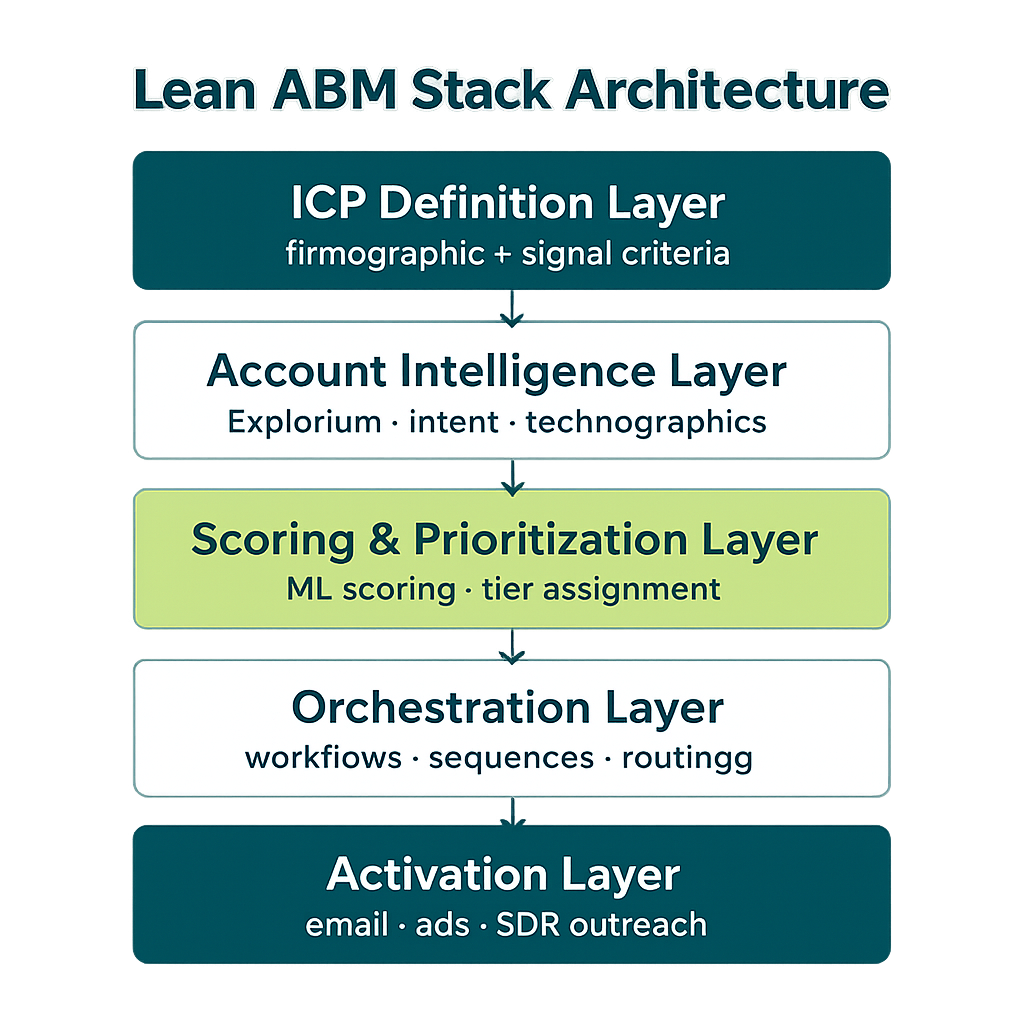
Layer 1: ICP Definition
Your Ideal Customer Profile is the foundation of everything downstream. A vague ICP — “mid-market SaaS companies” — will produce a target account list that is too broad to orchestrate effectively. A precise ICP — “Series B or C B2B SaaS companies with 50–500 employees, using Salesforce, with at least one dedicated RevOps hire, headquartered in North America” — gives you a filterable, verifiable definition that can be operationalized in a data query.
The best ICPs are built backward from closed-won data. Analyze your last 50 closed-won accounts. What firmographic attributes do they share? What technologies were in their stack at the time of sale? What hiring patterns preceded the deal? This analysis will surface the leading indicators of fit that most teams ignore because they’re hard to observe without good data infrastructure. With access to B2B data enrichment at scale, you can systematically profile your best customers and translate those characteristics into a queryable ICP definition.
Layer 2: Account Selection
Account selection is the process of applying your ICP definition to a universe of companies and producing a prioritized target account list. In a lean stack, this is a data query, not a manual research exercise. You need access to a company database large enough to be comprehensive and accurate enough to be trustworthy. Explorium’s 150M+ company profiles, matched at 97.8%+ accuracy, provide the foundation for this query.
The output of account selection is a tiered account list. Tier 1 accounts are your best-fit, highest-priority targets — typically 50–150 accounts that warrant full-court ABM treatment. Tier 2 accounts are good fits but lower priority or lower buying signal density — suitable for programmatic ABM. Tier 3 accounts are on the watch list: they meet some ICP criteria but need a trigger event before you invest significant resources.
Layer 3: Enrichment
Once you have your account list, you need to enrich each account with the data points that will power scoring, segmentation, and personalization. This includes firmographic data (revenue, employee count, industry, sub-industry, geography), technographic data (current tech stack, recent installs and uninstalls), and organizational data (leadership team, recent hires, org chart signals). Waterfall enrichment — cascading through multiple data sources to maximize fill rate — is the right approach for lean stacks that can’t afford to leave fields blank. See our deep dive on waterfall enrichment strategies for a full walkthrough of how to sequence providers to maximize coverage without overpaying.
Layer 4: Signal Monitoring
This is where lean ABM gets its competitive edge over both traditional outbound and low-effort ABM. Signal monitoring means continuously watching your target accounts for behavioral and contextual events that indicate buying intent or readiness. The signal types that matter most for B2B ABM include: intent data (third-party research behavior on relevant topics), technographic changes (new installs or removals of complementary or competitive tools), hiring signals (new VP hires, job postings for roles that precede a buying decision), news triggers (funding rounds, acquisitions, expansions), and web activity (visits to your pricing page, case study downloads, demo requests). A robust B2B buying signals program monitors all of these continuously and scores them by relevance to your ICP.
Layer 5: CRM-Native Activation
Activation is where signals become coordinated touches. In a lean stack, this means building workflows in your CRM that trigger automatically when an account crosses a scoring threshold. A Tier 1 account that shows a cluster of high-intent signals should automatically: alert the assigned account executive, enqueue a personalized LinkedIn message from the AE, trigger a targeted ad campaign on LinkedIn, and schedule a follow-up review in 72 hours. None of this requires a dedicated ABM platform — it requires clean data flowing into your CRM and well-designed automation workflows.
| Layer | Job to Be Done | Lean Stack Option | Enterprise Alternative | Integration Point |
|---|---|---|---|---|
| ICP Definition | Define the filterable profile of your ideal customer | Explorium company query API + closed-won analysis | 6sense Audience Builder | CRM custom object or spreadsheet |
| Account Selection | Build and tier a target account list from ICP criteria | Explorium 150M+ company database + firmographic filters | Demandbase ABM Platform | CRM account import |
| Enrichment | Fill account records with firmographic, technographic, and org data | Explorium waterfall enrichment API | ZoomInfo + Bombora bundle | CRM field sync via webhook |
| Signal Monitoring | Detect buying intent, tech changes, hiring, news events | Explorium 80+ signal types + Bombora intent topics | G2 Buyer Intent + Bombora | CRM scoring field update |
| Activation | Trigger coordinated sales + marketing touches | HubSpot/Salesforce workflows + LinkedIn Campaign Manager API | Terminus, RollWorks | CRM workflow automation |
| Measurement | Track account engagement, pipeline velocity, attribution | CRM dashboards + account engagement score | Demandbase Analytics, Bizible | CRM reporting |
Building Account Scoring Without 6sense or Demandbase
The account scoring model is the intelligence layer of your lean ABM stack. It takes raw data inputs — firmographic fit, technographic signals, intent data, hiring patterns, engagement history — and produces a single score per account that determines how aggressively you pursue it and when. Enterprise ABM platforms sell proprietary AI scoring as a core feature; the reality is that a well-designed weighted scoring model built in Python and synced to your CRM will outperform a black-box algorithm on most B2B datasets, because you can tune it to your specific ICP and update it as you learn what actually predicts conversion.

The scoring model has two distinct components: fit score and intent score. The fit score measures how closely an account matches your ICP — it is static on a quarterly basis and reflects firmographic and technographic characteristics. The intent score measures how actively the account is showing buying signals right now — it is dynamic and should update at least daily. The combined account score is a weighted average of fit and intent, with weights adjusted based on your sales cycle. For products with long, committee-driven sales cycles, fit score should carry more weight. For products with shorter, trigger-driven cycles, intent score should dominate.
Here is a production-ready Python implementation of a lean ABM account scoring model that pulls enrichment data from the Explorium API, computes fit and intent scores, and writes the results back to HubSpot via its CRM API:
import requests
import json
from datetime import datetime, timedelta
from typing import Optional

# --- Configuration ---
EXPLORIUM_API_KEY = "YOUR_EXPLORIUM_API_KEY"
HUBSPOT_ACCESS_TOKEN = "YOUR_HUBSPOT_TOKEN"
EXPLORIUM_BASE_URL = "https://api.explorium.ai/v1"
HUBSPOT_BASE_URL = "https://api.hubapi.com"

# --- ICP Fit Scoring Weights ---
FIT_WEIGHTS = {
    "employee_count": 0.20,        # 50-500 employees = max score
    "revenue_range": 0.20,         # $5M-$100M ARR = max score
    "industry_match": 0.25,        # SaaS, FinTech, MarTech = max
    "tech_stack_fit": 0.20,        # Salesforce present = +0.20
    "revops_hire": 0.15            # RevOps role in org = +0.15
}

# --- Intent Signal Weights ---
INTENT_WEIGHTS = {
    "bombora_intent_topic": 0.30,   # Active Bombora topic match
    "hiring_vp_revenue": 0.25,      # VP Sales/Marketing/RevOps hire
    "funding_event": 0.20,          # Series B/C in last 90 days
    "tech_change": 0.15,            # Competitive/complementary install
    "web_engagement": 0.10          # Pricing or demo page visit
}

def get_explorium_signals(domain: str) -> dict:
    """Fetch buying signals and firmographic data for a domain."""
    headers = {"Authorization": f"Bearer {EXPLORIUM_API_KEY}",
               "Content-Type": "application/json"}
    payload = {"domain": domain, "signal_categories": [
        "intent", "hiring", "technographic", "funding", "news"
    ]}
    resp = requests.post(
        f"{EXPLORIUM_BASE_URL}/signals/company",
        headers=headers,
        json=payload,
        timeout=10
    )
    resp.raise_for_status()
    return resp.json()

def compute_fit_score(firmographics: dict) -> float:
    """Compute ICP fit score (0.0 - 1.0) from firmographic data."""
    score = 0.0
    emp = firmographics.get("employee_count", 0)
    if 50 <= emp <= 500:
        score += FIT_WEIGHTS["employee_count"] * 1.0
    elif 20 <= emp < 50 or 500 < emp <= 1000:
        score += FIT_WEIGHTS["employee_count"] * 0.5

    rev = firmographics.get("annual_revenue_usd", 0)
    if 5_000_000 <= rev <= 100_000_000:
        score += FIT_WEIGHTS["revenue_range"] * 1.0
    elif rev > 100_000_000:
        score += FIT_WEIGHTS["revenue_range"] * 0.3

    icp_industries = {"saas", "fintech", "martech", "hr_tech", "devtools"}
    if firmographics.get("industry_tag", "").lower() in icp_industries:
        score += FIT_WEIGHTS["industry_match"] * 1.0

    tech_stack = set(firmographics.get("technologies", []))
    if "Salesforce" in tech_stack:
        score += FIT_WEIGHTS["tech_stack_fit"] * 1.0
    elif "HubSpot" in tech_stack:
        score += FIT_WEIGHTS["tech_stack_fit"] * 0.7

    if firmographics.get("has_revops_role", False):
        score += FIT_WEIGHTS["revops_hire"] * 1.0

    return min(score, 1.0)

def compute_intent_score(signals: list) -> float:
    """Compute intent score (0.0 - 1.0) from recent signal events."""
    score = 0.0
    ninety_days_ago = datetime.utcnow() - timedelta(days=90)

    for signal in signals:
        sig_type = signal.get("signal_type", "")
        sig_date = datetime.fromisoformat(signal.get("detected_at", "2000-01-01"))
        if sig_date < ninety_days_ago:
            continue  # Only count recent signals

        recency_multiplier = 1.0 if (datetime.utcnow() - sig_date).days <= 30 else 0.6

        if sig_type == "bombora_intent_topic":
            score += INTENT_WEIGHTS["bombora_intent_topic"] * recency_multiplier
        elif sig_type in ("vp_sales_hire", "vp_marketing_hire", "vp_revops_hire"):
            score += INTENT_WEIGHTS["hiring_vp_revenue"] * recency_multiplier
        elif sig_type in ("series_b_funding", "series_c_funding"):
            score += INTENT_WEIGHTS["funding_event"] * recency_multiplier
        elif sig_type in ("competitive_install", "complementary_install"):
            score += INTENT_WEIGHTS["tech_change"] * recency_multiplier
        elif sig_type == "pricing_page_visit":
            score += INTENT_WEIGHTS["web_engagement"] * recency_multiplier

    return min(score, 1.0)

def compute_account_score(domain: str,
                          fit_weight: float = 0.45,
                          intent_weight: float = 0.55) -> dict:
    """Main scoring function: returns fit, intent, and combined scores."""
    data = get_explorium_signals(domain)
    firmographics = data.get("firmographics", {})
    signals = data.get("signals", [])

    fit = compute_fit_score(firmographics)
    intent = compute_intent_score(signals)
    combined = (fit * fit_weight) + (intent * intent_weight)

    tier = "T3"
    if combined >= 0.75:
        tier = "T1"
    elif combined >= 0.50:
        tier = "T2"

    return {
        "domain": domain,
        "fit_score": round(fit, 3),
        "intent_score": round(intent, 3),
        "combined_score": round(combined, 3),
        "account_tier": tier,
        "scored_at": datetime.utcnow().isoformat()
    }

def update_hubspot_account(hs_company_id: str, score_data: dict) -> None:
    """Write account scores back to HubSpot company record."""
    headers = {
        "Authorization": f"Bearer {HUBSPOT_ACCESS_TOKEN}",
        "Content-Type": "application/json"
    }
    payload = {
        "properties": {
            "abm_fit_score": str(score_data["fit_score"]),
            "abm_intent_score": str(score_data["intent_score"]),
            "abm_combined_score": str(score_data["combined_score"]),
            "abm_account_tier": score_data["account_tier"],
            "abm_scored_at": score_data["scored_at"]
        }
    }
    resp = requests.patch(
        f"{HUBSPOT_BASE_URL}/crm/v3/objects/companies/{hs_company_id}",
        headers=headers,
        json=payload,
        timeout=10
    )
    resp.raise_for_status()
    print(f"Updated HubSpot company {hs_company_id}: tier={score_data['account_tier']}, "
          f"score={score_data['combined_score']}")

# --- Example usage ---
if __name__ == "__main__":
    accounts = [
        {"domain": "acme-saas.com", "hs_id": "12345678"},
        {"domain": "betafintech.io", "hs_id": "23456789"},
        {"domain": "gammahr.co", "hs_id": "34567890"}
    ]
    for acct in accounts:
        scores = compute_account_score(acct["domain"])
        update_hubspot_account(acct["hs_id"], scores)
        print(json.dumps(scores, indent=2))
This model runs daily via a cron job or an n8n workflow and keeps your CRM account scores current without any manual intervention. The key design choices: recency multiplier on signals (a funding event from 25 days ago is worth more than one from 80 days ago), separate fit and intent weights (tunable per product line), and a tier assignment that maps directly to activation playbooks in your CRM. When an account moves from T3 to T2, it triggers a light-touch nurture sequence. When it moves to T1, it triggers the full-court press.
| Signal Type | Source | Update Frequency | ABM Use Case | Weight in Intent Score |
|---|---|---|---|---|
| Bombora Intent Topic Match | Bombora (via Explorium) | Weekly | Prioritize accounts researching relevant topics; personalize messaging to the specific topic cluster | High (0.30) |
| VP-Level Revenue Hire | Explorium hiring signals | Daily | Trigger immediate AE outreach; new leader often evaluates vendors in first 90 days | High (0.25) |
| Series B/C Funding Event | Explorium news signals | Daily | Initiate expansion or new-logo outreach; newly funded companies invest in GTM infrastructure | Medium-High (0.20) |
| Competitive Tech Install | Explorium technographic signals | Weekly | Trigger competitive displacement playbook; account has demonstrated budget and buying intent in category | Medium (0.15) |
| Complementary Tech Install | Explorium technographic signals | Weekly | Trigger integration-led outreach; account has just created a new use case your product can serve | Medium (0.15) |
| Pricing Page Visit | First-party web analytics | Real-time | Immediately alert AE; highest-intent signal available; indicates active evaluation | Medium (0.10) |
| Job Posting for Relevant Role | Explorium hiring signals | Daily | Infer budget and initiative; headcount in a specific function signals a new program your product supports | Low-Medium (0.10) |
| Executive LinkedIn Activity | First-party social monitoring | Daily | Identify content topics and pain points; personalize outreach to executive’s stated priorities | Low (0.05) |
Signal-Driven Account Orchestration in Practice
The difference between a lean ABM program that works and one that fails often comes down to a single question: what triggers a touch? Calendar-driven programs send touches on a schedule. Signal-driven programs send touches when something meaningful happens. The former floods prospects with low-relevance outreach at predictable intervals. The latter delivers relevant, timely messages that feel less like marketing and more like a well-timed conversation.
Signal-driven orchestration requires two things: a reliable signal stream and a trigger-action framework in your CRM. The signal stream is handled by your enrichment and scoring layer — Explorium’s 80+ buying signal types across 18 categories, refreshed continuously, give you the raw material. The trigger-action framework is the set of if/then rules in your CRM that translate signal events into specific coordinated actions across sales and marketing.
Here is what a signal-driven orchestration workflow looks like in practice. The following webhook payload example shows the structure of a real-time signal event delivered by the Explorium AgentSource MCP server to a CRM workflow endpoint. The MCP server supports 100 QPS synchronous delivery, which means even large target account lists can receive near-real-time signal updates:
// Explorium AgentSource MCP - Real-Time Signal Webhook Payload
// Delivered to: https://your-crm.com/webhooks/abm-signal-intake
// Method: POST
// Content-Type: application/json

{
  "event_id": "sig_01HXKM7P3QRST9ABCDEF01234",
  "event_type": "account_signal_cluster",
  "delivered_at": "2026-05-05T14:32:11.892Z",
  "account": {
    "domain": "acme-saas.com",
    "company_name": "Acme SaaS Inc.",
    "explorium_company_id": "exp_co_0987654321",
    "crm_account_id": "0012x00001ABCdEFGH",
    "current_tier": "T2",
    "previous_tier": "T3"
  },
  "score_change": {
    "previous_combined_score": 0.48,
    "current_combined_score": 0.76,
    "delta": 0.28,
    "tier_change": true,
    "new_tier": "T1"
  },
  "triggering_signals": [
    {
      "signal_type": "vp_sales_hire",
      "signal_category": "hiring",
      "detected_at": "2026-05-04T09:15:00Z",
      "person_name": "Jordan Mitchell",
      "person_title": "VP of Sales",
      "confidence": 0.94
    },
    {
      "signal_type": "bombora_intent_topic",
      "signal_category": "intent",
      "detected_at": "2026-05-03T00:00:00Z",
      "topic": "Sales Intelligence Platforms",
      "surge_score": 82,
      "weeks_active": 3
    },
    {
      "signal_type": "competitive_install",
      "signal_category": "technographic",
      "detected_at": "2026-05-02T00:00:00Z",
      "technology_installed": "Apollo.io",
      "category": "Sales Engagement"
    }
  ],
  "recommended_actions": [
    {
      "action_type": "alert_account_executive",
      "priority": "urgent",
      "message": "Acme SaaS just hired a new VP of Sales, is surging on intent for Sales Intelligence Platforms, and recently installed Apollo.io. Tier upgrade from T2 to T1. Recommend immediate personalized outreach referencing the new hire."
    },
    {
      "action_type": "enqueue_linkedin_sequence",
      "sequence_id": "t1_vp_hire_trigger",
      "delay_hours": 2
    },
    {
      "action_type": "activate_paid_campaign",
      "campaign_id": "linkedin_t1_competitive_displacement",
      "budget_daily_usd": 25
    }
  ]
}
When this payload lands in your CRM webhook endpoint, it should immediately: create a task for the assigned AE with the full signal context, update the account tier and score fields, enqueue the appropriate LinkedIn outreach sequence, and activate the corresponding paid media campaign for that account. The entire chain of events — from signal detection to coordinated multi-channel touch — should execute within minutes, not days.
The key insight here is that the signal cluster approach is more reliable than any individual signal. A single intent topic surge might be noise. A VP hire plus intent surge plus competitive install happening within the same two-week window is a buying signal cluster that indicates real, active evaluation. Your scoring model should reward clusters explicitly, not just sum individual signals linearly. In the Python model above, this is handled by the recency multiplier and the additive scoring across signal types — signals that happen close together in time produce a combined score that exceeds what either would produce alone.
Running ABM without an enterprise budget? Explorium gives lean teams access to 150M+ company profiles, 80+ buying signals, and intent data — all via API, no annual contract required. Build your lean ABM stack →
CRM-Native Orchestration vs. Dedicated ABM Platforms
The question teams ask most often when designing a lean ABM stack is some version of: “At what point do I actually need Demandbase or 6sense?” The honest answer is: later than most vendors will tell you, and only if you’ve already validated your ABM model at the account level and need capabilities that are genuinely difficult to replicate without a dedicated platform.
CRM-native orchestration — building your ABM workflows inside HubSpot, Salesforce, or Pipedrive — has significant advantages for lean teams. First, there is no data model reconciliation. Your CRM is already the system of record for account and contact data; adding ABM signals to the same system means your AEs see signal data in the same interface they use for every other part of their workflow. Second, your existing CRM workflows, sequences, and reporting infrastructure can be extended to cover ABM use cases without building a parallel system. Third, the cost delta is enormous: CRM-native ABM might cost $500–$2,000 per month in additional data costs; a dedicated ABM platform typically costs $3,000–$10,000 per month at minimum.
The limitations of CRM-native orchestration become real at specific scale thresholds. When your target account list exceeds 500 accounts in active orchestration, managing the workflow logic in a CRM becomes complex enough to require dedicated operations support. When you need intent data integrated across more than five or six signal sources simultaneously, a dedicated platform’s unified data model offers real efficiency gains. And when your paid media orchestration requires dynamic audience updates at the individual ad-set level across LinkedIn, Google, and display simultaneously, CRM-native solutions start to show their limits.
| Dimension | Enterprise ABM Platform (6sense, Demandbase) | Lean ABM Stack (Explorium + CRM + API tools) |
|---|---|---|
| Annual Cost | $60,000–$200,000+ | $6,000–$24,000 |
| Implementation Time | 3–6 months | 2–6 weeks |
| Account List Capacity | Unlimited (scales with license) | 50–500 active accounts optimal |
| Intent Data | Proprietary + Bombora bundled | Bombora via Explorium, configurable |
| Signal Types | 20–40 built-in signal types | 80+ signal types via Explorium API |
| CRM Integration | Deep native connectors | Webhook + API (requires configuration) |
| Paid Media Orchestration | Native ad syndication to major platforms | API-driven via LinkedIn Campaign Manager, Google Ads |
| Reporting / Attribution | Built-in multi-touch attribution dashboards | CRM custom reports + manual attribution model |
| Technical Requirement | Low (managed platform) | Medium (requires RevOps or growth engineer) |
| Best For | 500+ account programs, large GTM teams | 50–500 account programs, lean GTM teams |
| Time to First Insight | Weeks (data pipeline setup) | Days (API-first, no onboarding) |
| Customizability | Limited to platform’s data model | Fully customizable scoring and workflow logic |
The right migration path is clear: start with CRM-native orchestration, validate your ABM model by proving account-level pipeline attribution, and upgrade to a dedicated platform only when you hit the specific scale thresholds above. Most B2B teams that invest in enterprise ABM platforms before validating their model end up with an expensive tool that nobody uses consistently — because the underlying ICP definition, signal logic, and activation playbooks were never proven out in the first place.
How Explorium Replaces the Enterprise Data Layer
In a lean ABM stack, the data layer is the most critical infrastructure decision. Every other component — scoring logic, CRM workflows, activation sequences — is only as good as the underlying data. This is where many lean ABM programs fail: they try to run account-based programs on data that is 6–18 months stale, covers fewer than 40% of their target accounts, or lacks the signal depth to differentiate a high-priority account from a low-priority one.
Explorium was built specifically to solve this problem. The platform aggregates data from 50+ sources — including Bombora for intent, multiple technographic providers, hiring data, news and funding feeds, and proprietary firmographic databases — and delivers it through a single, low-latency API. For lean ABM teams, this means you get the breadth of a multi-vendor data stack through a single integration point, without the overhead of managing five separate data contracts and reconciling conflicting company records across providers.
The numbers that matter for ABM programs specifically: 150M+ company profiles give you comprehensive global coverage so that no ICP-matching company falls through the cracks. 800M+ people profiles enable contact-level personalization when you’re ready to run multi-threaded account programs. 97.8%+ company match accuracy means that when you enrich a domain, you get the right company record, not a near-miss from a similarly named entity. And 80+ buying signal types across 18 signal categories — from Bombora intent topic surges to VP-level hiring events to technographic installs — give you the signal density to build scoring models that actually differentiate between accounts that are ready to buy and accounts that just look like they might be.
The AgentSource MCP server is the integration mechanism that makes all of this practical for lean teams. Rather than building batch ETL pipelines to pull data on a nightly schedule, the MCP server delivers signal events in real time at up to 100 QPS synchronously. This means your account scores can reflect a signal that happened this morning by the time your AE checks their task queue this afternoon. For signal-driven orchestration to work at the speed that actually creates competitive advantage, real-time delivery is not optional — and the 100 QPS throughput means even large target account lists receive near-instantaneous updates when signal clusters form.
For teams doing intent data-driven B2B prospecting, Explorium’s Bombora integration is particularly valuable. Bombora’s intent topics — which track research behavior across a network of B2B publishers — are most powerful when combined with firmographic fit and behavioral signals. Explorium surfaces Bombora intent data alongside all other signal types in a unified record, so your scoring model doesn’t have to join datasets from different providers. The result is a more accurate intent signal because surge scores are contextualized by what else is happening at the account.
Teams that need AI-powered lead generation capabilities alongside their ABM program will find that Explorium’s people profiles and enrichment API support both motions simultaneously. When a Tier 1 account shows a buying signal cluster, you can immediately query for the right contacts — the specific personas who would be involved in evaluating your product — and enrich their records with direct contact information, LinkedIn profiles, and role-specific attributes. This contact-level enrichment layer, built on top of account-level scoring, is what separates ABM programs that generate real pipeline from those that generate impressive dashboards.
Coordinating Sales and Marketing Through Shared Account Data
One of the oldest problems in B2B revenue is the misalignment between sales and marketing. Marketing generates MQLs; sales ignores them. Sales wants better leads; marketing says they’re already sending their best. ABM was supposed to solve this by making both teams work from the same account list — but in practice, enterprise ABM platforms often create a new layer of complexity that neither team owns clearly. The marketing team manages the platform; the sales team uses the CRM. The data still lives in two places.
Lean ABM, executed through the CRM, eliminates this problem structurally. When account scores, signal events, and engagement history all live in the CRM account record, sales and marketing are literally looking at the same data every time they open an account. There is no “platform view” and “CRM view” that need to be reconciled. The AE can see exactly which signals fired this week, what marketing campaigns the account has been exposed to, and what content they’ve engaged with — all in a single interface. Marketing can see whether the AE has followed up on signal-triggered alerts, which helps them tune the sensitivity of their triggers to avoid alert fatigue.
The operational framework for lean ABM coordination is straightforward. Marketing owns: the target account list (with quarterly reviews), the scoring model tuning, the signal monitoring configuration, and the content assets associated with each account tier and signal type. Sales owns: the relationship with assigned accounts, the timing and tone of direct outreach, and the qualification of accounts that show interest. Both teams share accountability for: the account engagement score (which reflects both marketing and sales touches), the pipeline created from the target account list, and the accuracy of the ICP definition based on what they’re seeing in conversations.
Weekly ABM syncs — 30 minutes, focused on accounts that have moved tiers or shown significant signal clusters in the past seven days — are the operational heartbeat of a lean ABM program. The agenda is simple: review accounts that crossed scoring thresholds, discuss what actions were taken, assess response and engagement, and decide whether any accounts should be moved up or down in tier priority. These syncs replace the longer, less focused marketing-sales alignment meetings that most teams dread, because they are grounded in specific accounts and specific signal data rather than abstract pipeline discussions.
Measuring ABM at the Account Level
Lead-level measurement is the enemy of ABM. When you measure MQL volume, cost per MQL, and lead-to-opportunity conversion rate, you are optimizing for a metric that has nothing to do with account-based program success. An ABM program that generates zero MQLs but adds three Tier 1 accounts to active pipeline is succeeding. An ABM program that generates 200 MQLs from non-ICP accounts is failing, regardless of what the dashboard shows.
Account-level measurement requires three distinct metrics: account engagement score, pipeline velocity, and multi-touch attribution at the account level. Account engagement score is a composite of all marketing and sales touches an account has received and responded to — email opens, ad clicks, content downloads, demo requests, AE meetings, and more. It tells you how deeply an account is engaging with your program overall, not just whether one contact opened one email. Accounts with rising engagement scores are moving through your program effectively; accounts with stagnant engagement scores need a different approach.
Pipeline velocity is the most business-critical account-level metric. It measures how quickly accounts move from first signal to qualified opportunity to closed-won, and at what deal size. In a lean ABM program, you want to track pipeline velocity separately for accounts that entered the program via different signal types — accounts that triggered on a VP hire might close faster but at smaller deal sizes than accounts that triggered on a Bombora intent surge. Understanding these patterns lets you tune your tier structure and signal weights over time.
Multi-touch attribution at the account level means crediting the specific combination of marketing and sales touches that preceded an opportunity — not attributing the deal to a single last-touch or first-touch event. For lean ABM programs, a simplified linear attribution model (equal credit to every touch in the account’s history before opportunity creation) is accurate enough to make strategic decisions without the complexity of Markov chain or algorithmic attribution models that enterprise platforms sell. The goal is not perfect attribution — it is directionally correct attribution that helps you understand which parts of your program are driving pipeline and which are not. See our guide on real-time intent APIs for GTM technical teams for a deeper discussion of attribution modeling with API-first data stacks.
| Metric | Definition | Update Frequency | Lean Stack Implementation | Success Threshold |
|---|---|---|---|---|
| Account Engagement Score | Weighted composite of all marketing + sales touches for an account in the trailing 90 days | Daily | CRM custom score field, updated by workflow on each touch event | Rising score over 4-week rolling window |
| Signal-to-Opportunity Rate | % of accounts that show a Tier 1 signal cluster and convert to qualified opportunity within 90 days | Monthly | CRM report: accounts with tier = T1 AND opportunity created within 90 days | >15% for well-tuned ICPs |
| Pipeline Velocity | Average days from first signal to opportunity creation; average days from opportunity to closed-won | Monthly | CRM opportunity date fields + signal first-detected date (custom field) | Decreasing quarter-over-quarter |
| Account Coverage Rate | % of target accounts with at least one meaningful marketing or sales touch in trailing 30 days | Weekly | CRM report: accounts in target list with last_touch_date within 30 days | >80% for Tier 1, >50% for Tier 2 |
| Tier Progression Rate | % of accounts that move from T3 → T2 or T2 → T1 within a quarter | Quarterly | CRM account tier field + historical tier tracking (custom object or activity log) | >10% per quarter indicates healthy signal flow |
| ABM-Sourced Pipeline % | % of total pipeline sourced from accounts on the target account list | Monthly | CRM opportunity report filtered by account in target list | Growing toward 40%+ of total pipeline |
Common Lean ABM Failure Modes and How to Avoid Them
Lean ABM programs fail in predictable ways. Understanding the failure modes before you encounter them is the fastest path to building a program that actually works. Here are the five most common failure modes and the specific mitigations that prevent each one.
Failure Mode 1: ICP That Is Too Broad. The most common lean ABM failure is an ICP definition so broad that it cannot meaningfully prioritize one account over another. “Mid-market B2B companies” is not an ICP — it is a TAM description. An ICP that does not specify technology requirements, hiring patterns, organizational maturity signals, or geographic constraints will produce a target account list of thousands of accounts that cannot be orchestrated effectively with a lean stack. The mitigation is to start with your 20 best closed-won customers, reverse-engineer the specific attributes that made them great fits, and build an ICP that would have identified those accounts before the first conversation. Then test the ICP against a fresh cohort of companies to verify that it produces a list of 100–300 accounts, not 3,000.
Failure Mode 2: Stale Data Poisoning the Model. A scoring model is only as good as the data it scores. If your firmographic data is 12 months old, your technographic data is from a quarterly dump, and your intent data is refreshed weekly at best, your scores will lag reality by enough to make them operationally useless. An account that raised a Series B six months ago and hired a new CMO three months ago should be a T1 target right now — but if your data hasn’t been refreshed, it might still be sitting in T3. The mitigation is to use a data provider that refreshes signal data at least daily and delivers it via API rather than batch export. Explorium’s real-time signal delivery and daily refresh cadence are specifically designed to prevent this failure mode. You can learn more about the mechanics of keeping enrichment data current in our guide to B2B data enrichment best practices.
Failure Mode 3: No Signal Trigger, Just ICP Fit. Selecting accounts based on ICP fit alone — without waiting for a signal that indicates active buying readiness — produces a list of good targets with no particular reason to engage now. The result is outreach that lands when accounts are not actively evaluating, which means low response rates and AE frustration. The mitigation is to require at least one meaningful intent signal before moving an account into active orchestration, and to require a signal cluster (two or more correlated signals within a 30-day window) before escalating to T1 treatment. Fit alone puts an account on the watch list. Fit plus signal moves it into active orchestration.
Failure Mode 4: Sales Ignoring ABM Alerts. Even the best signal-driven orchestration system fails if the sales team doesn’t act on the alerts it generates. Alert fatigue is real: if every account on the target list generates alerts every week, AEs will stop reading them within a month. The mitigation is to keep your T1 list small (50 accounts maximum in active orchestration at any time), set high thresholds for alert generation (only tier upgrades and signal clusters above a defined severity threshold), and include the full signal context in every alert so AEs understand immediately why this account matters right now. Alerts that say “Acme SaaS is a T1 account” are ignored. Alerts that say “Acme SaaS just hired a new VP of Sales, is surging on intent for your category, and installed your competitor last week” get immediate attention.
Failure Mode 5: Measuring the Wrong Things. Lean ABM programs that measure MQL volume, email open rates, or ad impressions will optimize for metrics that have nothing to do with account-based success. The teams running these programs will make decisions that look correct by the metrics but actively harm the ABM program — like expanding the target account list to generate more leads, or optimizing email subject lines for open rates rather than relevance to the account’s current buying context. The mitigation is to commit to account-level metrics from day one, even if it means your dashboards look less impressive in the short term. Pipeline sourced from target accounts, account engagement score trajectories, and signal-to-opportunity conversion rates are the metrics that tell you whether your lean ABM stack is actually working.
Graduating from Lean to Full ABM
A well-executed lean ABM program is not a permanent state — it is a proving ground. The goal is to validate your ICP definition, scoring model, signal logic, and activation playbooks at a manageable scale before investing in the infrastructure required to run ABM at enterprise scale. When your lean program is working — generating 30%+ of pipeline from target accounts, producing consistent signal-to-opportunity conversion rates above 15%, and running with predictable AE follow-through on signal alerts — you have the evidence base to justify investing in dedicated ABM infrastructure.
The graduation signals are specific and measurable. You are ready to invest in a dedicated ABM platform when: your target account list has grown beyond 500 active accounts and CRM workflow complexity is creating operational debt; your paid media orchestration requires real-time audience updates across more than three channels simultaneously; your intent data requirements exceed what a single provider can cover and you need a unified multi-source intent model; or your attribution requirements demand algorithmic multi-touch attribution that CRM-native reporting cannot provide accurately.
The graduation process itself should be treated as a data migration and model validation exercise, not a fresh start. Everything you’ve built in your lean stack — the ICP definition, the scoring weights, the signal types, the activation playbooks — should be imported into the new platform and validated against historical data before you rely on the platform’s proprietary model. Many teams that switch to enterprise ABM platforms and abandon their lean stack learnings discover that the platform’s default model performs worse on their specific ICP than the tuned model they built themselves. Preserve your institutional knowledge, even as you upgrade your infrastructure.
For teams not yet ready to graduate — or teams that want to understand exactly what the graduating threshold looks like from a data and signal perspective — our guide on intent data for B2B marketing covers the full signal architecture that underlies both lean and enterprise ABM programs. And for teams thinking about how AI-native prospecting fits into their evolving stack, our overview of AI lead generation approaches covers the intersection of machine-learning-driven prospecting and account-based orchestration.
FAQs


